Healthcare operations involve hundreds of small tasks every day. From appointment booking and patient registration to queue management, patient calling, reminders, follow-ups, and daily reporting, hospital and clinic staff spend a significant amount of time coordinating routine activities.
These tasks are necessary. But they don't always need to be manual.
This is where the use of AI in hospitals can make a meaningful difference. The goal is not to replace hospital staff. The goal is to automate repetitive operational work so staff can spend more time helping patients and supporting doctors.
For outpatient departments (OPDs), this becomes even more important. As patient volumes increase, manual coordination can lead to longer waiting times, overloaded reception teams, missed appointments, and poor visibility into daily operations.
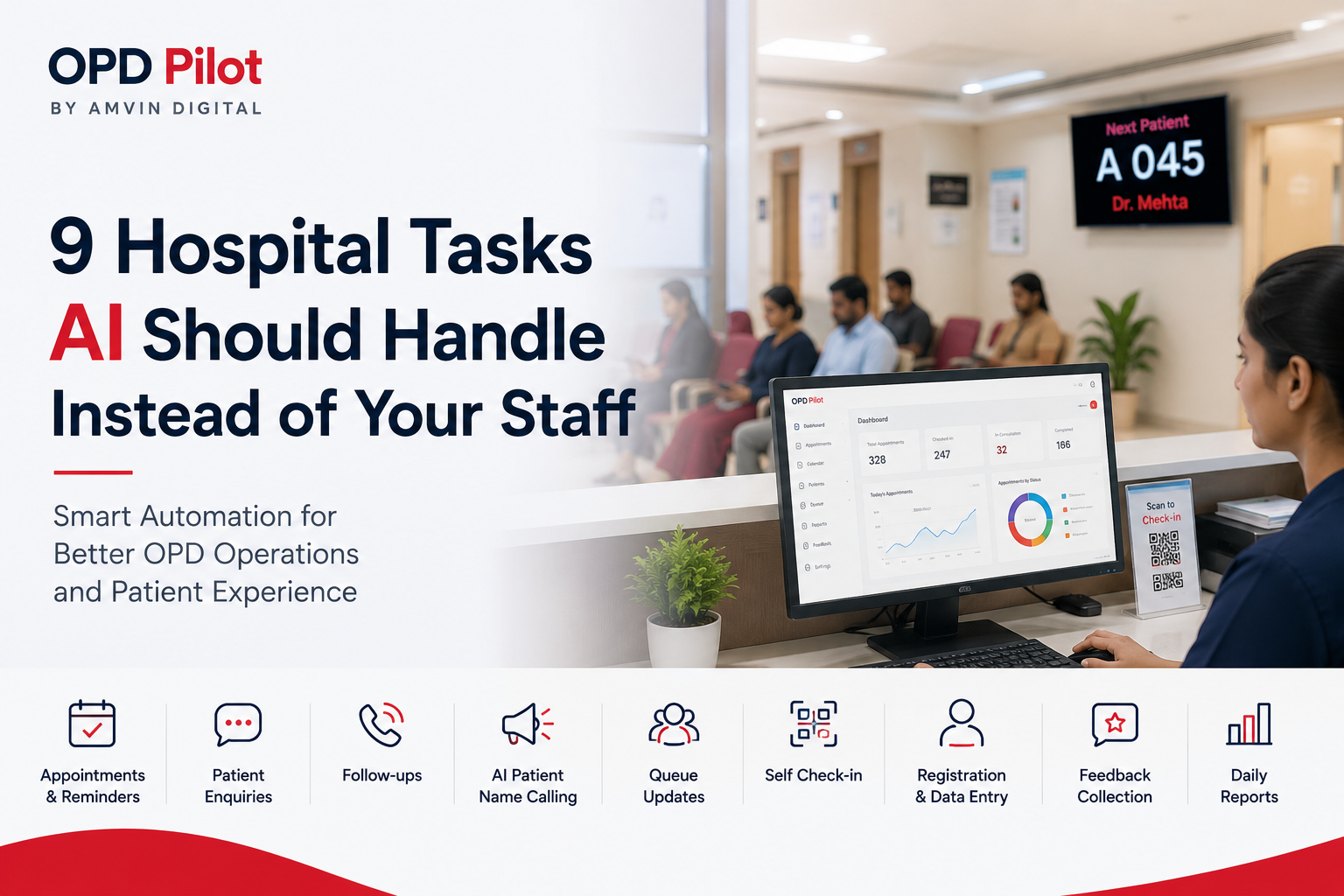
This is where AI for hospitals, combined with workflow automation and real-time visibility, can help create a more connected patient journey. Here are 9 hospital and clinic tasks where AI used in hospitals can reduce repetitive work and improve OPD operations.
1. Patient Routine Enquiries
Reception teams answer the same patient questions repeatedly throughout the day:
- When is my appointment?
- What is my token number?
- Is the doctor available?
- How many patients are ahead of me?
Individually, these questions take only a few minutes. Across hundreds of patients, they can consume hours of staff time. One of the practical applications of AI in hospitals is automating routine patient communication.
An intelligent patient communication system can provide patients with appointment information, queue updates, doctor status, and other routine information through digital channels. Instead of calling the reception desk for every update, patients can access relevant information themselves.
2. Automated Hospital Appointment Reminders
Appointment reminders are one of the simplest hospital tasks to automate. Yet many clinics still depend on staff to manually call or message patients before their appointments.
A modern doctor appointment system can automatically send timely reminders through WhatsApp, email, SMS, or other configured communication channels.
Messages can include:
- Doctor name
- Appointment date
- Appointment time
- Token or booking number
- Rescheduling information
- Arrival instructions
This is an important example of the use of AI in hospitals because the technology can take care of repetitive communication without requiring staff to remember every individual follow-up. Automated reminders also create a more consistent communication process.
3. Patient Follow-ups
The patient journey does not end when the consultation is completed. Patients may need reminders about their next appointment or other planned interactions with the hospital.
Manual follow-ups can quickly become difficult when a hospital manages hundreds of patients every day. Automation can help hospitals maintain consistent communication by sending relevant follow-up messages based on appointment and patient journey events.
For example:
- Upcoming appointment reminders
- Rescheduling notifications
- Cancellation messages
- Completed appointment communication
- Missed appointment communication
- Feedback requests
This is another practical area where AI for hospitals can reduce repetitive administrative work. The objective is to make patient communication timely, consistent, and connected to the OPD journey.
4. Patient Queue Updates
One of the biggest challenges in a busy OPD is keeping patients informed about their turn. Patients often approach reception and ask: "When is my turn?" Every such interaction requires staff time.
A modern hospital queue management system can make queue information visible to both staff and patients. Patients can track their queue position digitally, while waiting-room displays can show upcoming tokens or booking numbers.
5. AI-powered Patient Name Calling
Instead of reception staff repeatedly calling patients across the waiting area, an automated voice announcement system can call patients when it is their turn.
The announcement can use information such as:
- Patient name
- Doctor name
- Token number
- Waiting position
For hospitals serving diverse populations, multilingual announcements can also improve accessibility. OPD Pilot supports browser-based voice announcements in English, Hindi, and Bengali, with configurable templates and automatic triggers.
6. Self-Service Patient Check-in
The reception counter can become one of the biggest bottlenecks during peak OPD hours. Patients arrive, staff verify their appointments, information is entered, and the patient is added to the queue. And the process repeats.
A digital patient check-in process can allow patients to confirm their arrival using their smartphones. With QR-based check-in, patients can enter the OPD workflow without requiring reception staff to manually process every arrival. The appointment can then move into the appropriate OPD flow, giving staff real-time visibility into who has arrived.
7. Doctor Schedule and OPD Flow Coordination
Managing an OPD is more complicated than simply booking appointments. Doctors take breaks. Patients arrive late. Appointments get cancelled. Walk-in patients arrive. Consultations take different amounts of time. And queues change throughout the day.
An intelligent OPD system can consider doctor schedules, appointment capacity, existing bookings, and patient status to help coordinate the day's appointments. Learn more about how OPD automation works in practice. Modern systems also provide live queue visibility and automation that can move patients through configured workflow stages efficiently.
8. Patient Registration and Data Entry
Manual patient registration creates unnecessary work for reception teams. It also creates an avoidable problem for returning patients. Why should a returning patient have to provide the same information again?
A modern OPD management system can identify existing patients and retrieve their available information. OPD Pilot supports patient search and auto-fill for returning patients, including information such as name, mobile number, address, email, language, and previous problem information. This can make repeat bookings significantly faster while helping reduce duplicate patient records.
9. Automated Patient Feedback Collection
Patient feedback is essential for improving the hospital experience. But collecting it manually is difficult. Staff may forget to ask. Patients may leave before providing feedback. And manually compiling responses takes additional administrative effort.
An automated patient feedback system can trigger feedback collection after a completed appointment. Patients can submit ratings and comments digitally, allowing hospital teams to identify recurring operational issues and understand patient experience more effectively.
10. Automated Daily OPD Reports
At the end of every OPD day, hospital leaders need visibility into what happened. How many patients were seen? How long were waiting times? Which doctors had the highest throughput? Did any appointments get missed? How was the patient experience?
Manual report compilation is time-consuming and error-prone. A modern OPD management system can automatically generate daily operational reports, including metrics such as patient count, average wait time, doctor performance, appointment completion rates, and feedback summaries.
These reports can be delivered automatically to hospital administrators and OPD heads, providing them with real-time operational visibility without requiring staff to compile data manually.
The Common Theme: Automate Coordination, Keep People Focused on Patients
The use of AI in hospitals should not mean automating everything. The better question is: Which hospital tasks consume staff time without requiring staff judgment?
These are often the best candidates for automation. For an OPD, that includes:
| Manual OPD Task | Automation Opportunity |
|---|---|
| Appointment reminders | Automated patient notifications |
| Queue questions | Live queue tracking |
| Patient calling | Automated voice announcements |
| Check-in | QR-based self-service check-in |
| Returning patient registration | Patient search and auto-fill |
| Queue movement | Automated OPD flow |
| Feedback collection | Automated post-visit feedback |
| Daily reporting | Automated dashboards and reports |
The common theme is simple: Automate coordination. Keep people focused on patients.
When these stages are connected, staff do not have to manually coordinate every transition. Patients receive information when they need it. Staff get better visibility. Doctors experience a more organized flow. Hospital leaders get better operational data. That is where AI used in hospitals can create practical value today.
How AI for Hospitals Can Improve the Patient Journey
When people search for AI for hospitals, they often think about complex clinical applications. But some of the most immediate opportunities are operational.
A hospital can start by improving the everyday patient journey:
Booking → Reminder → Arrival → Check-in → Queue → Patient Calling → Consultation → Feedback
When these stages are connected, staff do not have to manually coordinate every transition:
- Patients receive information when they need it
- Staff get better visibility
- Doctors experience a more organized flow
- Hospital leaders get better operational data
That is where AI used in hospitals can create practical value today.
Ready to Reduce Repetitive Work in Your OPD?
If your reception team spends too much time calling patients, answering queue questions, sending reminders, updating statuses, or preparing reports, the problem may not be your staff. It may be the amount of manual coordination your OPD requires.
OPD Pilot helps hospitals move toward a more connected, automated, and visible OPD. Run a smarter OPD. Reduce repetitive work. Give your team more time for patients.
Frequently asked questions
The use of AI in hospitals includes automating repetitive administrative and operational tasks such as appointment communication, patient queue updates, patient calling, digital check-in, follow-ups, feedback collection, and reporting.
AI for hospitals can reduce waiting and uncertainty by keeping patients informed about appointments, queue positions, doctor availability, and their turn. Automation can also reduce repetitive work at the reception desk.
The benefits of AI in hospitals can include reduced manual work, faster patient communication, better operational visibility, smoother patient flow, more consistent follow-ups, and improved staff productivity.
Yes. An automated voice announcement system can use patient information to call patients by name when it is their turn. This can reduce manual patient calling at the reception desk and improve the waiting-room experience.
OPD automation means using technology to automate repetitive outpatient department processes such as appointment communication, check-in, queue updates, patient calling, patient flow coordination, feedback collection, and reporting.